
The wbk Industrial Assembly Task Board is a modular robotic benchmark developed by the wbk Institute of Production Science at KIT (Karlsruhe Institute of Technology). This resource provides comprehensive instructions for constructing the task board hardware and detailed guidelines for evaluating robotic systems on a variety of benchmark tasks. Whether you are referencing this material online or as a compiled document, you will find all the necessary information to build, configure, and utilize the task board for research, development, or benchmarking purposes. If you are using a compiled document (such as PDF), you can always access the latest online version at: https://industrial-assembly-taskboard.readthedocs.io/en/latest/ .
Why This Task Board?
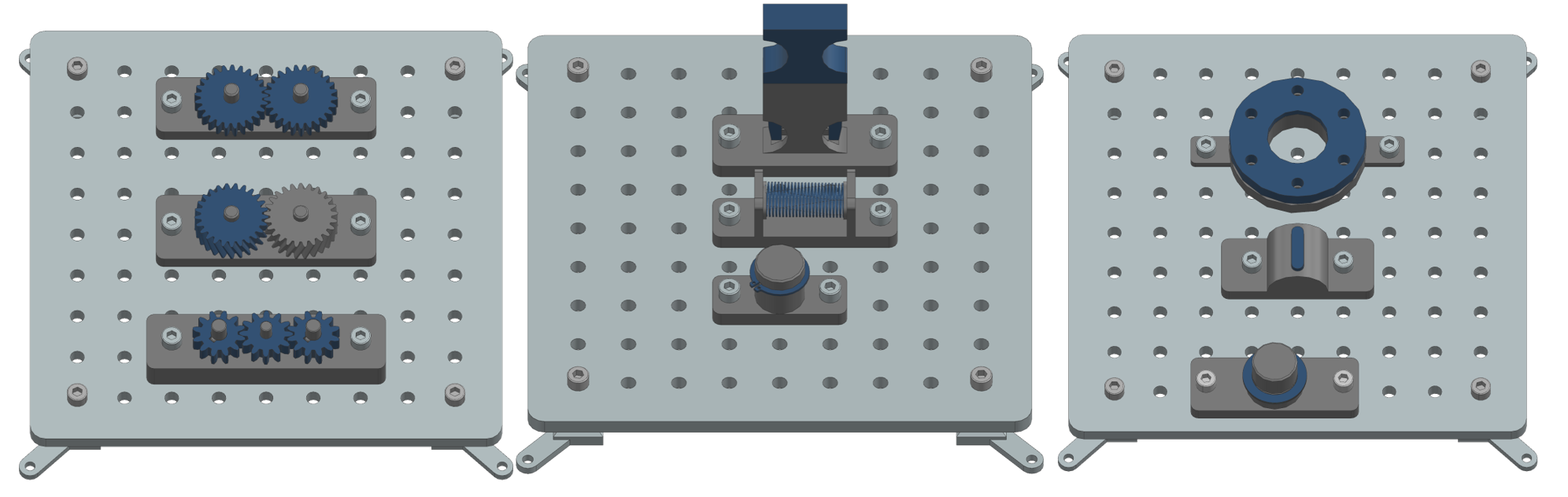
Robotic assembly is far more complex than the basic “peg-in-hole” tasks often used in benchmarks like the NIST task board [1]. While such benchmarks are valuable, they assume that the only thing more complex than a simple peg-in-hole task is the geometry of the peg and hole, or the manipulation of cables and belts. In reality, industrial assembly tasks involve a wide range of challenges, including precise tolerances, compliant assembly, and the need for advanced planning and adaptability since different parts of an assembly may interact in unexpected ways.
The goal of this task board is to provide a set of tasks that showcases these additional complexities encountered in industrial practice. These tasks are designed to challenge robotic agents with scenarios that require advanced planning, precision, and adaptability. The modular design of the board allows users to mix and match tasks depending on the specific complexities they wish to address.
We provide all 3D-printable files in this repository for anyone to build their own task boards: https://github.com/WBK-Robotics/industrial-assembly-taskboard
Note
This task board is not intended to be a complete benchmark for all aspects of robotic assembly. Instead, it serves as a starting point for exploring the complexities of industrial assembly tasks. We encourage users to extend the task board with their own modules and tasks that reflect real-world challenges. If you have ideas for new tasks, please contribute by opening a Pull Request with your files and task descriptions.
This documentation is split into two main sections:
Assembly Guide – step‑by‑step hardware build instructions (3D‑printing,purchased fasteners, mounting sequence).
Robot Task Guide – formal task definitions (motion sequence, tolerances and success criteria) for benchmarking your robot or algorithm on each module.
Note
If you are new to the benchmark, follow the quick‑start steps below. Power users can jump directly to the Assembly or Robot Task guides via the sidebar.
Read the Assembly Guide to build the base task board and alldesired task modules.
Choose a module and open its page in the Task Descriptions to understand the robot’s motions and evaluation metrics.
Implement your robot program, run experiments, and compare results!
Citation
If you use this task board in your research, please cite our paper:
@misc{https://www.radar-service.eu/radar/en/dataset/3c5yh8z8asafagby.,
        doi = {10.35097/3c5yh8z8asafagby},
        author = {Baumgärtner, Jan and Kreft, Laurin and Puchta, Alexander and Fleischer, Jürgen},
        keywords = {Robotic Assembly and Industrial Automation and Peg-in-Hole and Pick-and-Place and Gear Assembly and Robotics and Industrial Robotics},
        title = {From Toy Problems to Industrial Reality: The wbk Assembly Benchmark},
        publisher = {Karlsruhe Institute of Technology},
        year = {2025}
}
Contents
- Assembly Guide
- How to use this guide
- Build Instructions
- Assembling Instructions: Task board
- Assembly Instructions: Peg-in-Hole
- Assembly Instructions: Pick and Place
- Assembly Instructions: Gear Assembly
- Assembly Instructions: Screws and Nuts
- Assembly Instructions: Elastic Deformation
- List of required Components
- Task Descriptions
References
[1] National Institute of Standards and Technology (NIST) Assembly Task Board: https://www.nist.gov/el/intelligent-systems-division-73500/assembly-task-board